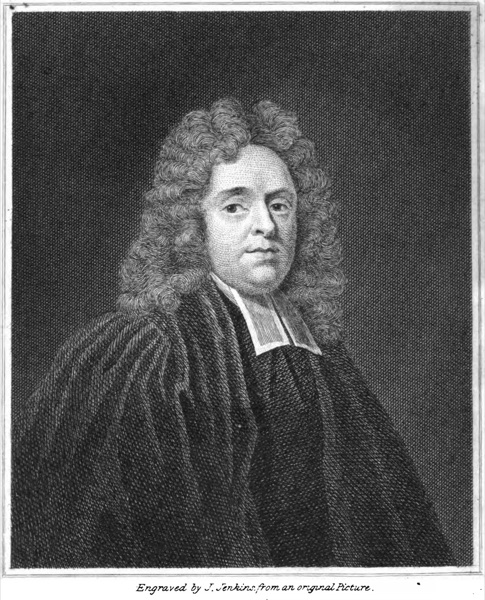
Matthew Henry was a British Nonconformist and Presbyterian minister, born in Wales but spending much of his life in England. He was the second son of Philip and Kathrine Henry, and he was born prematurely at his mother's family estate, Broad Oak, on the borders of Flintshire and Shropshire. His father, a Church of England cleric, had just been ejected under the Act of Uniformity 1662, but unlike many ejected ministers he had some private means and could give his son a good education. By the age of nine, Henry could write Latin and read part of the Greek New Testament. He later studied law at Gray's Inn in London but soon gave up legal studies for theology.
In 1686 he accepted an invitation to move to Chester, Cheshire, and establish a congregation. He was ordained on 9 May 1687 and became minister of a new Presbyterian congregation there. The congregation grew under his leadership, and in 1699 he oversaw the construction of a new building. Henry became a popular speaker, traveling almost weekly to different cities to speak. He preferred an expository speaking style and would remain close to the literal interpretation of biblical passages. In 1712 he moved to Mare Street, Hackney, to take over the ministry of the Hackney congregation, partly because his great commentary was nearing publication and Hackney was close to the publisher.
Henry is best known for his six-volume Exposition of the Old and New Testaments, published between 1708 and 1710. It provides an exhaustive paragraph-by-paragraph study of the Bible, covering the whole of the Old Testament and the Gospels and Acts in the New Testament. After his death, thirteen other nonconformist ministers finished the sixth volume, covering Romans through Revelation, partly based on notes taken by Henry's hearers. His commentaries are primarily theological, dealing with the scripture text as presented, with his prime intention being explanation for practical and devotional purposes.
Henry's Commentary was highly commended by famous evangelical Protestant preachers. George Whitefield read it through four times, the last time on his knees. Charles Spurgeon said every minister ought to read it entirely and carefully through once at least. John Wesley published an abbreviated edition and praised Henry as a person of strong understanding, solid piety, and much experience in the ways of God, noting that his exposition is generally clear and intelligible, expressed in plain words, and practical throughout. Henry died on 22 June 1714 of apoplexy while on a speaking tour, after being thrown from his horse but insisting on continuing to Nantwich where he was scheduled to speak.
Based on the Wikipedia article “Matthew Henry” (https://en.wikipedia.org/wiki/Matthew_Henry), CC BY-SA 4.0.
Portrait: Wikimedia Commons, Public domain. https://commons.wikimedia.org/wiki/File:Matthew_Henry_Portrait_1707.png
