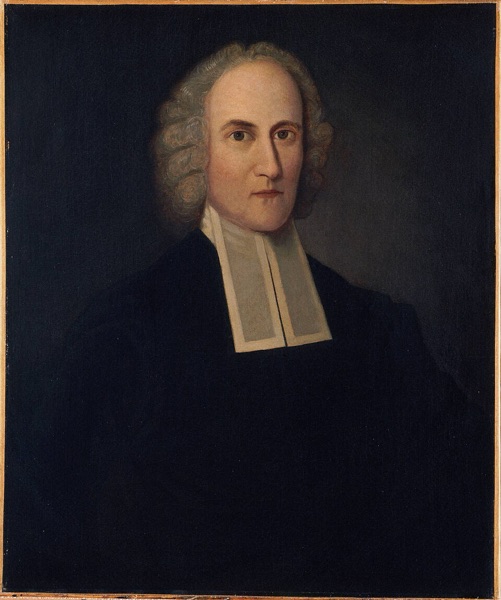
Jonathan Edwards was an American revivalist preacher, philosopher, and Congregationalist theologian. He is widely regarded as one of America's most important and original philosophical theologians. His theological work was broad in scope but rooted in the Puritan heritage as exemplified in the Westminster and Savoy Confessions of Faith. Recent studies have emphasized how thoroughly Edwards grounded his life's work on conceptions of beauty, harmony, and ethical aptness, and how central the Age of Enlightenment was to his mindset.
Edwards was born on October 5, 1703, in East Windsor, Connecticut, the fifth of 11 children and only son of Timothy Edwards, a minister. He entered Yale College in 1716 at just under the age of 13. During his college studies, he kept notebooks labeled The Mind, Natural Science, The Scriptures, and Miscellanies. He was interested in natural history and wrote an essay detailing the ballooning behavior of some spiders. In 1727, Edwards was ordained minister at Northampton and assistant to his grandfather Solomon Stoddard. In the same year, he married Sarah Pierpont. After Stoddard died in 1729, Edwards held the sole ministerial charge of one of the largest and wealthiest congregations in the colony.
Edwards played a critical role in shaping the First Great Awakening and oversaw some of the first revivals in 1733–35 at his church in Northampton. At a 1741 revival in Enfield, Connecticut, he delivered the sermon Sinners in the Hands of an Angry God, a classic of early American literature. He is well known for many books, including A Dissertation Concerning the End for Which God Created the World, The Life of David Brainerd, which inspired thousands of missionaries throughout the 19th century, and Religious Affections, which many Calvinist Evangelicals still read today.
In 1751, Edwards became pastor of the church in Stockbridge, Massachusetts, and a missionary to the Housatonic Indians. During this time he composed the treatises on which his reputation as a philosophical theologian chiefly rests, including the essay on Original Sin, the Dissertation Concerning the Nature of True Virtue, the Dissertation Concerning the End for which God created the World, and the great work on the Will, published in 1754 under the title An Inquiry into the Modern Prevailing Notions Respecting that Freedom of the Will which is supposed to be Essential to Moral Agency.
Edwards was installed as president of the College of New Jersey, now Princeton University, on February 16, 1758. Almost immediately after becoming president, he decided to get inoculated for smallpox in order to encourage others to do the same. Never having been in robust health, he died as a result of the inoculation on March 22, 1758. His work gave rise to a doctrine known as New England theology, and his writings and beliefs continue to influence individuals and groups to this day.
Based on the Wikipedia article “Jonathan Edwards (theologian)” (https://en.wikipedia.org/wiki/Jonathan_Edwards_(theologian)), CC BY-SA 4.0.
Portrait: Wikimedia Commons, Public domain. https://commons.wikimedia.org/wiki/File:Jonathan_Edwards_(Princeton_Portrait).jpg
